
Whoa!
I was poking around a dev channel one night and felt like the explorer tools were seven years behind where they should be.
At first glance, Solana’s speed and cheap fees make everything feel effortless.
But then I started digging into provenance and token flows and—seriously—things got messy fast.
My instinct said: you need better visibility than the wallet UI gives you, and you need context for on-chain events that matter to collectors and traders alike.
Okay, so check this out—NFT tracking on Solana isn’t just about “who owns what” anymore.
Medium-level dashboards that show floor swaps are helpful.
But you also want lineage, metadata updates, creator royalties, and signs of wash trading.
On one hand the chain is transparent, though actually raw data can be noisy and hard to interpret without tools layered on top.
Something felt off about relying on wallets alone; I kept missing flash events and low-fee micro-transfers that mattered.
Here’s the thing.
You can monitor a collection in three pragmatic ways that actually work day-to-day: watch addresses, track token mints, and follow marketplace activity.
I set up address watchers for primary sellers and high-activity traders.
Then I sampled token mints for suspicious duplication or metadata rewrites.
Over time those three signals correlated with short-term price moves and collector sentiment, which made me rethink my trade timing.
Hmm… I should say I’m biased toward hands-on analysis.
I love tools that show raw instructions and parsed events side-by-side.
Initially I thought a pretty chart was enough, but then realized parsing instruction data (like token transfers inside a program call) is crucial.
Actually, wait—let me rephrase that: pretty charts are good for onboarding, but not for forensic questions when someone claims a “rug”.
So I started using explorers that let me dive into transaction-level details and program logs without leaving my browser.
Why token trackers and analytics matter right now
Short answer: liquidity and legitimacy.
Longer answer: on Solana, tiny fees let actors move assets in and out quickly, which is great for traders but bad for anyone trying to follow provenance manually.
Collectors want to know if a token’s metadata was updated after sale.
Markets want to detect wash trades and circular trading that inflate floor prices.
My takeaway: if you can’t slice on-chain events by program, by token mint, and by marketplace, you’re flying blind.
I’ve relied heavily on explorers that parse program instructions into readable events.
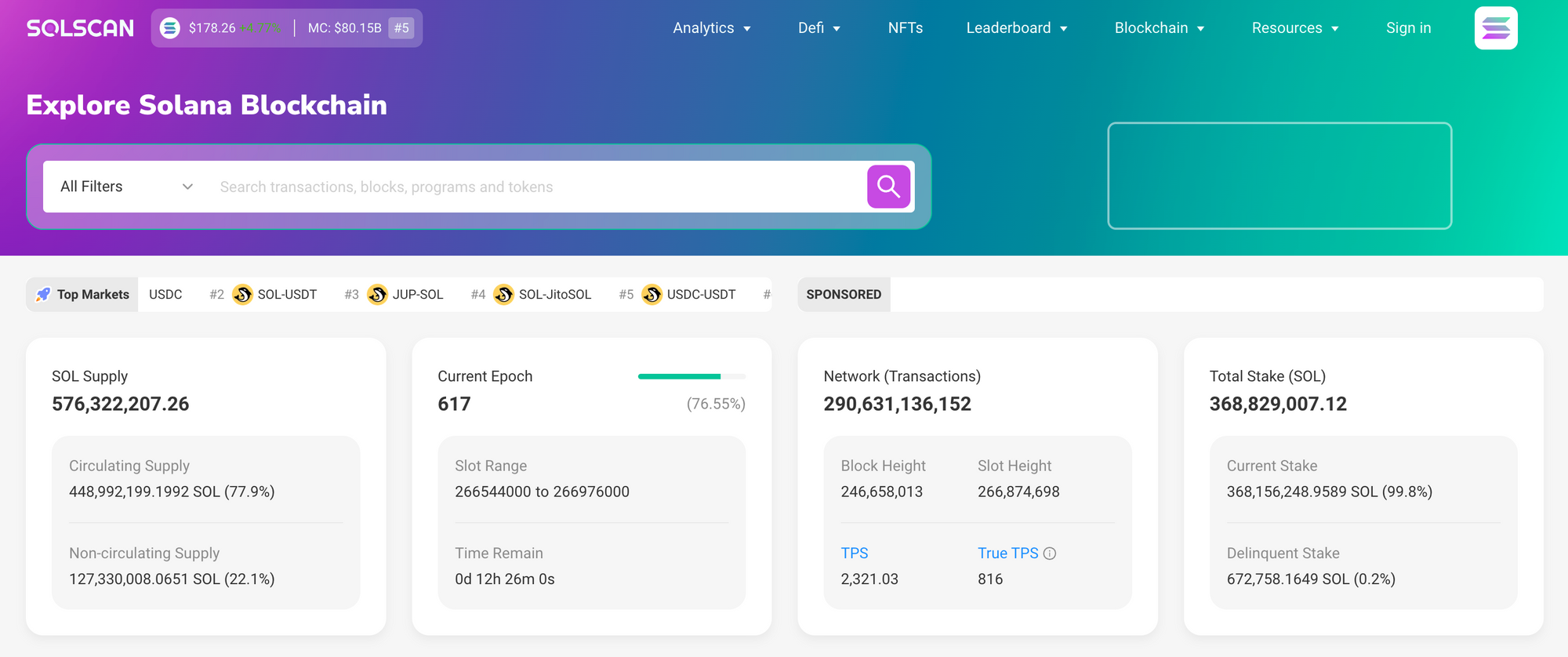
One tool I recommend for daily sleuthing is solscan, which I use for quick lookups and deeper transaction decoding.
It’s fast, shows token holders, and surfaces program calls without making me decode base58 by hand.
I’m not saying it’s perfect—no tool is—but it’s saved me hours of manual tracing.
Also, if you’re trying to spot bot activity, the timestamp clustering and repeated signer patterns are your best bets.
Thing that bugs me about some dashboards: they hide the raw stuff.
I want both parsed summaries and the raw transaction bytes.
Not everyone needs that level of granularity, though—just depends on whether you’re a collector or a compliance person.
For collectors, lineage and metadata history rank high.
For traders, liquidity depth and taker-maker dynamics are more very very important.
Practical tips I use, in no particular order:
1) Watch the mint activity for a collection for 48–72 hours after launch.
2) Flag any metadata updates tied to an upgradeable authority.
3) Trace large transfers to marketplaces and back to known market-making addresses.
These are simple heuristics.
They catch most of the obvious fud and pump patterns.
On the analytics side, you want three views: on-chain raw, parsed event timeline, and cross-market price feeds.
Why? Because cross-market mismatches often precede arbitrage or sudden floor drops.
At times I saw floor listings on one marketplace while another still showed higher bids—opportunity, or a price discovery lag.
Initially I treated those as noise; then I started seeing patterns that predicted big sweeps.
So now I pay attention to inter-market spreads.
One thing I learned the hard way: watch out for contract-level quirks.
Some collections have lazy metadata or adopt nonstandard royalty enforcement.
On one collection (I won’t name names), royalties were enforced only by off-chain agreements, which led to chaos when marketplaces changed policies.
That taught me to validate the on-chain mint and the update authority before trusting a collection’s royalty claims.
Somethin’ as simple as a mismatched update authority can mean the collection’s economics shift overnight.
Quick checklist — what to monitor daily
– Mint counts and mint velocity.
– Top holders and concentration metrics.
– Recent metadata updates and who triggered them.
– Marketplace sweep patterns and volume spikes.
– Repeated tiny transfers between same addresses (possible wash patterns).
These are the signals that give you early warning.
People ask me: do you need to be a dev to do this?
Nope.
You do need curiosity and a few good tools.
If you’re willing to click through transaction details and learn program names, you’ll get a lot farther than relying on social feeds alone.
And yeah—it’s time-consuming at first, but it becomes a muscle.
FAQs
How do I start tracking an NFT collection?
Begin by bookmarking the collection’s mint address and monitoring the holder distribution.
Look for concentration in a few wallets; extreme concentration can indicate centralized control.
Then watch marketplace listings and the last 100 transactions to see who the active traders are.
If you use a reliable explorer that decodes program events you’ll be able to see transfer instructions and where tokens move during sweeps.
Can token trackers help detect wash trading?
Yes.
Patterns like rapid back-and-forth transfers between a small set of addresses, especially with identical amounts and short timing gaps, are red flags.
Combine that with marketplace orderbook snapshots and you’ve got a pretty clear signal.
No single metric proves intent, though—context matters.
